

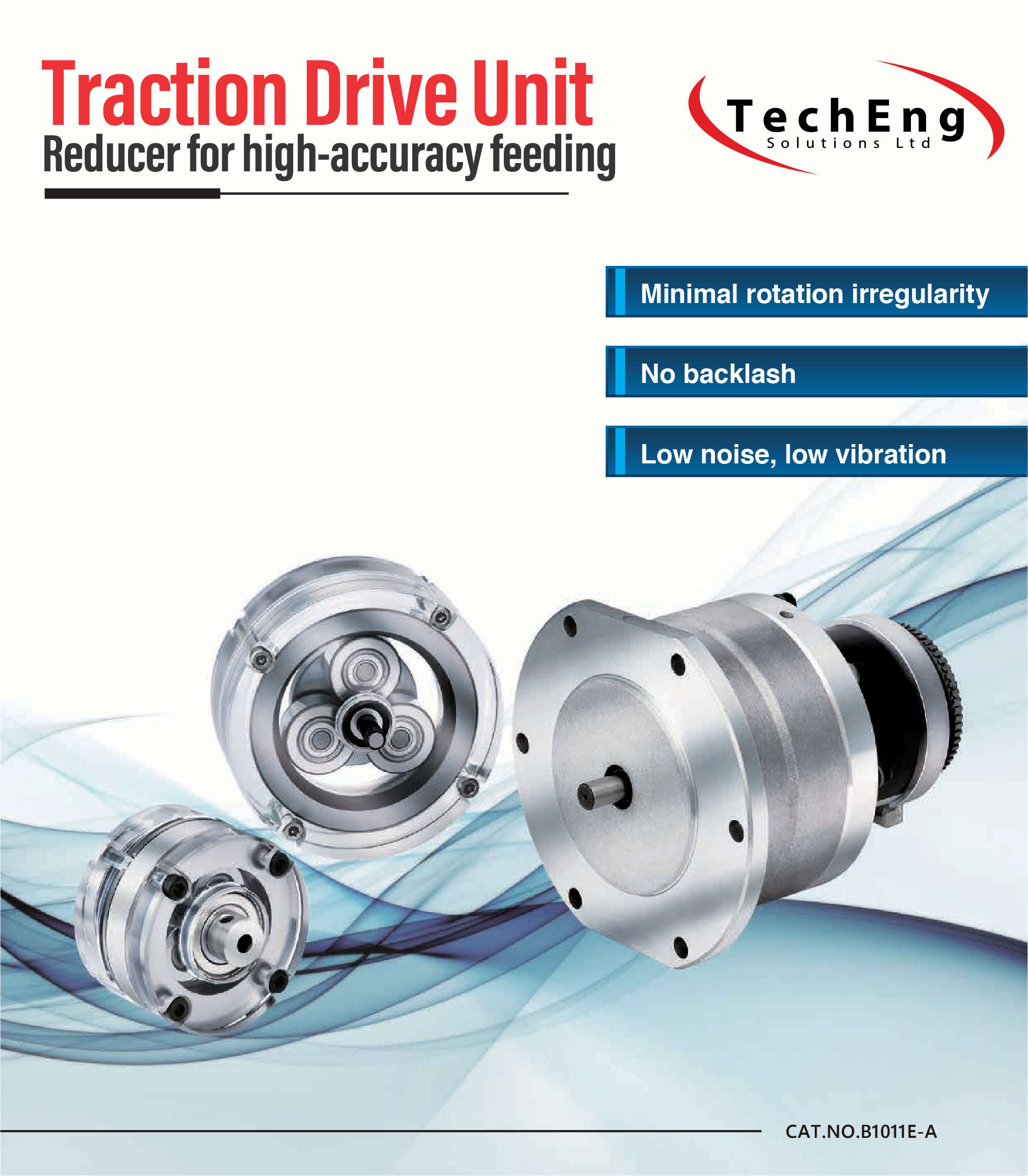





A Rraction Drive Unit is a power transmission system that transfers power through rolling contact between smooth components, often with a special traction fluid to enhance friction. This system relies on traction force rather than the interlocking teeth used in traditional gears. The smooth, rolling motion of traction drives results in low noise and vibration, making them a good alternative to gear and belt drives in various applications.
How a Traction Drive Unit Works
A traction drive unit consists of a driving roller, a driven roller, and a mechanism to apply pressure between them. A special traction fluid is used to lubricate the contact points. When a high-pressure force is applied, this fluid temporarily becomes highly viscous, creating a thin, solid-like film that prevents metal-to-metal contact while effectively transferring torque.
This allows for smooth and efficient power transmission. The speed ratio can be either fixed or, in the case of a continuously variable transmission (CVT), can be adjusted smoothly over a wide range.
Key Features and Applications
Traction drives have several notable characteristics:
Continuous Speed Variation: Unlike traditional gearboxes that have discrete shift points, traction drives can continuously vary the speed ratio. This “infinite” number of shift points allows for optimal performance and efficiency.
Low Noise and Vibration: Because there are no meshing teeth, traction drives operate very quietly and smoothly.
High Efficiency: Their design can achieve high efficiency, often approaching that of the best gear drives.
Traction drives are found in a variety of applications where smooth, quiet, and efficient power transmission is needed. They are used in:
Automobiles (e.g., in some CVTs)
Industrial machinery
Superchargers and turbochargers
HVAC systems
For example, in elevators, both geared and gearless traction systems are used. Geared traction elevators use a gearbox to drive the hoisting sheave, while gearless traction elevators connect the motor directly to the sheave. Gearless systems are more efficient, quieter, and can operate at higher speeds, making them ideal for high-rise buildings.